
Problems
Railway
Maintenance Challenges
Rail systems operate under demanding and dynamic conditions, depending on high-speed mechanical components, heavy loads, and continuous motion across vast networks. Unplanned failures in these systems not only result in costly service disruptions and maintenance operations, but also pose serious risks to passenger safety, infrastructure integrity, and overall network performance.
The Most Common Railroad Malfunctions and Their Causes
These types of failures in railway systems reduce operating efficiency, increase
maintenance costs and pose a risk to passenger transportation.
Wheel-Rail Mechanism
Faults
Wheel wear
Rail cracks or breakage
Rail wear and slip detection
Rail joint issues
Generator & Electrical
Faults
Generator grounding
problems
Loose connector phasing
Shorted laminations
Loose stator windings
Main Engine & Rotor Issues
Broken or cracked rotor
bars
Loose rotor bar joints
Stator eccentricity
Eccentric rotor issues
Thermal rotor blow
Loose rotor on the shaft
Bogie & Bearing Issues
Outer race damage
Inner race damage
Ball damage
Cocked bearing on the shaft
Cocked bearing in the housing
Cage damage
Creeping damage
Radial and axial clearance issues
Overload failures
Gearbox Failures
Tooth skiving
Tooth wear
All gear-mesh anomalies
Overload conditions
Eccentricity issues
Misalignment
Excessive backlash
Cracked or broken teeth
Hunting tooth frequency detection
Coupling Issues
Coupling unbalance
In-parallel coupling faces misalignment
Coupling wear & tear
Locked coupling issues
Wedge damage
Solutions
DS-XR Revolutionizing Railway Maintenance with AI

Minimize Downtime, Reduce Costs, Maximize Safety!
Traditional railway maintenance depends on periodic inspections and reactive fixes—often after faults have caused delays or damage.But in modern rail systems, AI-powered predictive maintenance is essential to maintain safety and efficiency. DS-XR integrates DS-Track sensors with the DS-Insight platform, enabling real-time monitoring of rolling stock and track conditions, and detecting faults before they lead to service disruptions.
How it Works
Delphisonic’s predictive maintenance system continuously monitors railway equipment with smart sensors and an AI-powered analytics platform. DS-Track collects real-time data from critical components on locomotives and infrastructure. This data is processed by DS-Insight to detect early signs of failure, optimize maintenance processes and prevent unplanned downtime. The result: safer, more efficient and uninterrupted railway operations.

DS-Track
DS-Track is a smart sensor that can be easily installed on locomotives, railcars and infrastructure. The sensors continuously monitor vibration, temperature and other critical parameters and collect data in real time. The installation steps are as follows: First, the sensors are installed on the bogies, wheel sets, gearboxes and other critical components. Then, data is sent to the DS-Insight software via wireless or wired connections. Finally, real-time analysis detects potential faults and generates alerts.

DS-Insight
DS-Insight is a software that provides AI-powered data processing and analysis. It works as follows: First, real-time vibration, temperature, and dynamic load data are collected from DS-Track sensors. Then, this raw data is transmitted to DS-Insight and processed by the AI-powered analysis engine. During the analysis, algorithms detect abnormal vibrations, signs of wear, and potential failures. The system alerts operators to critical issues and provides maintenance recommendations. Finally, the data is displayed on a user-friendly dashboard, and maintenance teams respond quickly.
Process
Step-by-Step Summary
DS-Track sensors are mounted on critical assets depending on industry-specific needs.
Data is analyzed locally in real time for early anomaly detection.
Machine learning identifies patterns, detects faults, and recommends maintenance actions.
Operators take targeted, fast action based on precise insights.
Continuous monitoring of vibration, temperature, and load data.
Data is sent to the central platform for deeper analysis and long-term tracking.
Only meaningful alerts are generated—minimizing unnecessary notifications.
Entire flow is tailored through DS modules for each industry
Process
Step-by-Step Summary
DS-Track sensors are mounted on critical assets depending on industry-specific needs.
Continuous monitoring of vibration, temperature, and load data.
Data is analyzed locally in real time for early anomaly detection.
Data is sent to the central platform for deeper analysis and long-term tracking.
Machine learning identifies patterns, detects faults, and recommends maintenance actions.
Only meaningful alerts are generated—minimizing unnecessary notifications.
Operators take targeted, fast action based on precise insights.
Entire flow is tailored through DS modules for each industry
Key Benefits for
Railway Operations with Delphisonic
Up to 95% failure prevention through real-time condition monitoring and Edge AI-driven anomaly detection — minimizing unplanned maintenance and unexpected breakdowns.
Up to 30% reduction in maintenance costs by enabling data-driven scheduling and eliminating unnecessary part replacements.
Enhanced safety and reliability with early warnings for mechanical faults such as bearing wear, wheelset imbalance, and gearbox failures — reducing the risk of derailments or infrastructure damage.
Increased operational efficiency by ensuring system uptime, improving asset utilization, and reducing emergency interventions.
Discover Delphisonic’s solutions to optimize your maintenance
processes and reduce operational risks and costs.
A Greener Future on Steel
Low energy, low emissions: The power of sustainability on rails
Rail transport maximizes energy efficiency thanks to the low-friction movement of
steel wheels on steel rails. With the integration of electrification and renewable
energy sources, it becomes a truly eco-friendly transportation solution by
minimizing carbon emissions.
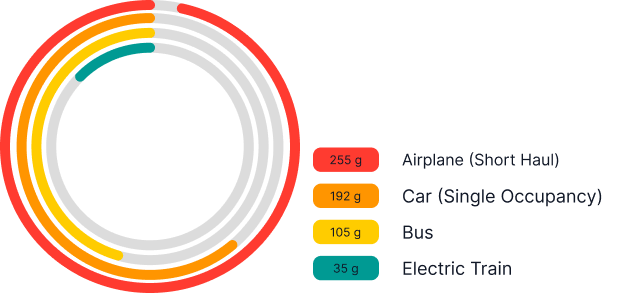
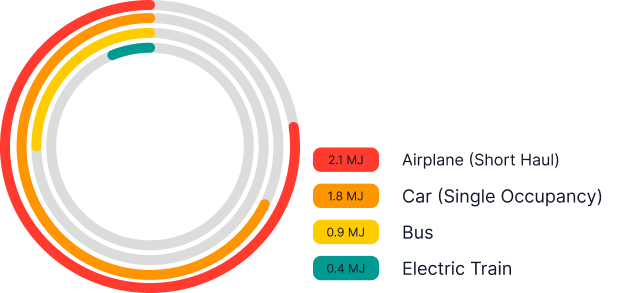
CO₂ Emissions by Transport Mode
Rail emits up to 7x less CO₂ than road, and up to 8x less than air travel.
Sources:
• Our World in Data – Travel Carbon Footprint
• IEA – The Future of Rail
CO₂ Emissions by Transport Mode
Rail emits up to 7x less CO₂ than road, and up to 8x less than air travel.
Sources:
• Our World in Data – Travel Carbon Footprint
• IEA – The Future of Rail
The Safest Track: Rail
An infrastructure built to move people — not risk
Rail transport has one of the lowest fatality rates among all motorized modes of
transportation. Dedicated infrastructure, automated signaling, and continuous
monitoring drastically reduce the risk of accidents.
Passenger Fatalities
Rail is around 70 times safer than road transport,and ranks among the safest motorized systems globally.
Sources:
• Eurostat – Railway Accident Statistics
• ETSC – Road Safety Progress
• Our World in Data – Transport Safety
Demand & Efficiency
The Backbone of Future Mobility:
Driven by urbanization, sustainability goals, and rising freight demands, rail is
becoming the most strategic transport infrastructure of the 21st century. By 2050,
global rail demand for both passengers and freight is expected to more than
double. With its capacity to carry thousands of passengers or tons of cargo in a
single trip, it offers a highly efficient and scalable solution.
Global Rail Demand Projections
According to the OECD and IEA, rail will become the backbone of global transport.Road and air infrastructure alone will not be able to meet future demand efficiently.
Sources:
• OECD ITF – Transport Outlook 2023
• IEA – The Future of Rail
Global Rail Demand Projections
According to the OECD and IEA, rail will become the backbone of global transport.Road and air infrastructure alone will not be able to meet future demand efficiently.
Sources:
• OECD ITF – Transport Outlook 2023
• IEA – The Future of Rail
AI-Driven Transformation
The Shift to Smart, Proactive Maintenance
Traditional railway maintenance relies on reactive or time-based interventions —
costly, risky, and inefficient. AI-powered predictive maintenance systems detect
early-stage faults before failures occur, enabling targeted, condition-based
interventions. This approach drastically reduces both downtime and maintenance
spend, while increasing system reliability.
Benefits of Predictive Maintenance
With platforms like DS-Insight, real-time sensor data is analyzed using machine learning to detect faults before they escalate.
Sources:
• McKinsey – Future of Rail Maintenance
• US DOE – Predictive Maintenance Guide
• [Delphisonic Field Data, 2024]
Why Delphisonic?
Delphisonic’s Railway Expertise
At Delphisonic, we have been delivering predictive maintenance and industrial monitoring solutions since 2012 — with a strong focus on the railway industry.
We combine AI-powered analytics with edge-based smart sensors to detect failures early, lower maintenance costs, and ensure uninterrupted operations.
We don’t just monitor rail systems — we engineer them from within, with deep technical know-how and industry-specific insight.
Let’s solve your railway challenges together.
Guide the future
Request a Demo

Solutions
Industries
Trust Center
Solutions
Trust Center

Solutions
Solutions
Trust Center
© Copyright 2026, All Rights Reserved by Delphisonic